
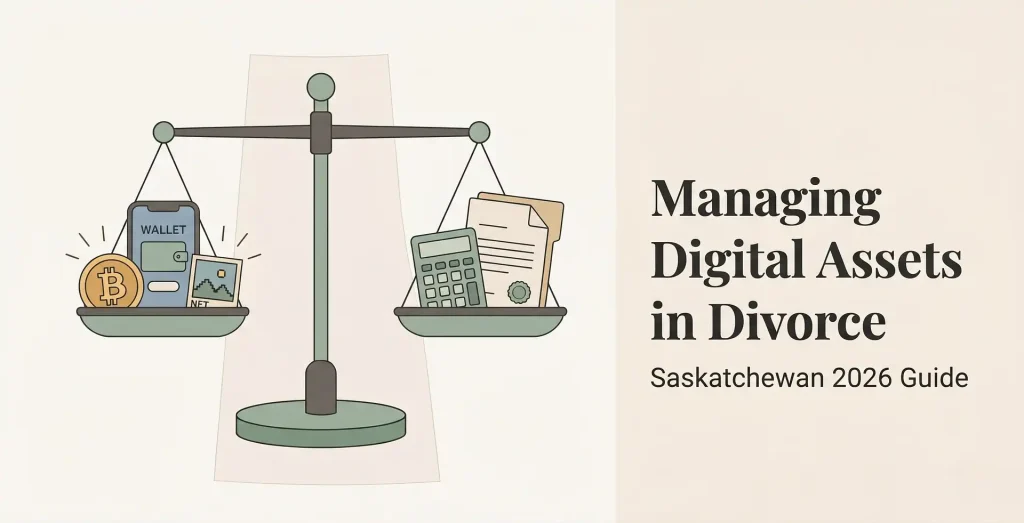
Dividing digital assets in a Saskatchewan divorce follows the same equal-division rule as any other marital property. But finding crypto wallets, valuing a monetized YouTube channel, or splitting an online business is a different challenge entirely.
Moose Jaw Divorce Lawyer has handled complex asset separations for decades. What we’ve seen shift dramatically in recent years is how much wealth now lives entirely online, and how often neither spouse fully understands what needs to be disclosed.
If you’re separating and digital wealth is part of the picture, here’s what Saskatchewan law actually requires.
What Counts as a Digital Asset in a Saskatchewan Divorce?
Any digital property with financial value is subject to Saskatchewan’s Family Property Act.
That includes cryptocurrency, online businesses, monetized social accounts, NFTs, domain names, loyalty points, and digital intellectual property. If it holds value and was acquired or grew during the marriage, it belongs in the property division calculation.
Most people underestimate how broad this category is.
Financial and Transferable Assets
Cryptocurrency like Bitcoin and Ethereum, NFT portfolios, and exchange accounts on platforms like Coinbase or Binance all fall squarely under Saskatchewan’s Family Property Act.
The presumption is equal division.
Crypto purchased during the marriage is fully divisible.
Pre-marital holdings may qualify for an exemption (meaning the value of the crypto you owned before the marriage can be excluded from the equal division calculation and kept entirely by you).
But any growth in value during the marriage remains subject to division, even if the original coins were owned before the relationship.
Full financial disclosure is mandatory. Concealing digital assets exposes the non-disclosing party to contempt findings and potentially unequal division orders.
Income-Generating Assets
Online businesses, monetized YouTube or Twitch channels, Shopify stores, affiliate websites, and domain portfolios all generate ongoing revenue.
Courts treat these as family property and value them based on historical earnings and projected future income.
A spouse who contributed to building these platforms, even indirectly through household support during the marriage, may have a valid claim to a share of that asset.
Personal and Sentimental Digital Property
Cloud-stored family photos, shared streaming accounts, and even digital game items all qualify as digital property. They’re harder to value, but not exempt.
Tradeable virtual items and accumulated rewards like Air Miles carry real monetary value and factor into the net family property calculation. Saskatchewan’s Fiduciaries Access to Digital Information Act (FADIA) provides a legal framework for accessing these assets without violating privacy protections.
How Do You Find Hidden Digital Assets in a Saskatchewan Divorce?
Hidden digital wealth is one of the biggest challenges in modern separations.
A hardware wallet holding hundreds of thousands of dollars in Bitcoin fits in a jacket pocket. An offshore exchange account leaves no traditional bank trail.
But that doesn’t mean they disappear.
The Digital Paper Trail
Blockchain transactions are permanent and public.
Even pseudonymous wallets leave traces that skilled investigators can follow. Bank wire transfers to crypto exchanges, PayPal histories, and recurring platform payments can all link a spouse to undisclosed accounts.
OSINT (open-source intelligence) tools go further, identifying linked email addresses, IP addresses, and exchange accounts. Courts draw adverse inferences from missing disclosure.
The consequences of hiding digital assets in a Moose Jaw or Saskatchewan divorce are serious.
Device Audits
Forensic specialists can scan computers, phones, and tablets for cryptocurrency wallet apps, browser extension wallets like MetaMask, transaction histories, and deleted files.
Physical hardware wallets, devices like Ledger or Trezor, must also be disclosed as personal property. A thorough device audit can uncover “cold storage” assets that leave virtually no online footprint.
Heads Up: If your spouse suddenly became less active on a monetized platform right before separation, that’s a red flag courts are well aware of.
Strategically reducing posting activity to deflate a channel’s apparent value is a known tactic, and one forensic experts can identify.
The Role of Forensic Accounting Experts
Forensic accounting for crypto in Saskatchewan divorces has become a specialized field.
These experts conduct blockchain analysis, cross-reference financial records with on-chain data, and produce court-admissible reports that identify hidden holdings.
They can also trace transfers made just before separation, sometimes used to move assets out of marital reach, and testify as expert witnesses.
Engaging a forensic specialist early gives your legal team a far stronger footing in complex cases.
How Are Digital Assets Valued in a Volatile Market?
Valuing digital assets is harder than valuing a house.
Cryptocurrency prices can swing dramatically within days. An NFT portfolio that was worth $200,000 at separation may be worth $80,000 by trial, or $400,000.
Date of Valuation vs. Date of Trial
Saskatchewan’s Family Property Act doesn’t prescribe a fixed valuation date, which creates room for disagreement.
In practice, courts often look to the fair market value at the time of the order. Parties can also agree on a specific date to reduce uncertainty, something worth negotiating early.
Expert appraisals using multiple exchange averages and historical pricing produce the most defensible numbers when market timing is disputed.
Tax Implications Under the CRA
The Canada Revenue Agency treats cryptocurrency as capital property.
That normally means dispositions trigger capital gains. However, under section 73(1) of Canada’s Income Tax Act, crypto and NFTs can be transferred between former spouses as part of a property settlement without triggering tax at the time of transfer, provided both parties are Canadian residents.
The rollover is automatic; no special CRA election is required.
But once the receiving spouse later sells the asset, capital gains are calculated from the original adjusted cost base. Accurate records of acquisition dates and costs are critical for both parties.
Pro Tip: Never agree to receive a crypto asset in a settlement without confirming the adjusted cost base. You could be inheriting a significant future tax liability that offsets the apparent value.
Valuing a Monetized Social Media Account
A spouse with 500,000 followers and active brand partnerships holds a substantial income-generating asset with no clear market comparator.
Courts treat monetized social media accounts as business assets, valued using historical earnings, engagement rates, market trends, and projected growth.
This is genuinely new territory in family law. We’re seeing it more often, and the valuations can be significant.
How Are Digital Assets Actually Divided?
Once assets are discovered and valued, there are three practical methods for dividing them under Saskatchewan’s equal-division framework.
The “Sell and Split” Method
Sell the asset and divide the net proceeds after fees and taxes. This eliminates valuation disputes and gives both spouses liquid capital.
The downside is market timing.
Selling during a dip means both parties receive less than the asset was worth at separation. For spouses without the technical knowledge to manage wallets independently, this is often the most practical path.
In-Kind Distribution
Transfer the digital asset directly, dividing a cryptocurrency portfolio proportionally between two wallets, for example.
This approach typically doesn’t trigger a taxable event at transfer, particularly under section 73(1) spousal rollover.
It preserves the asset intact and works well for NFTs or unique digital holdings that can’t be liquidated without significant value loss.
The Offset Strategy
One spouse retains the digital asset.
The other receives equivalent value in other marital property, a larger share of real estate equity or a pension, for instance.
This is a clean solution when one party is more comfortable managing digital assets. A neutral third-party appraisal is essential. Values must be agreed upon before the exchange, not estimated.
Best Practice: For shared income-generating platforms, negotiate a formal transition agreement at the time of settlement. It should define who manages the account, for how long, and how any ongoing revenue is split during the transition period.
Who Owns Intellectual Property Created During a Marriage?
Content created during the marriage, vlogs, branded photography, original music, and AI-generated art, is intellectual property subject to division.
Under principles established in Pettkus v. Becker and applied through Canadian family law, a spouse who contributed meaningfully to the creation or support of IP assets may hold a claim even without formal ownership.
Pre-marital IP generally stays separate property.
But any increase in its value during the marriage is divisible under Saskatchewan’s Family Property Act. Documentation matters here: creation dates, copyright registrations, and royalty agreements all help establish origin and ownership.
Privacy Protections During Digital Discovery
Divorce proceedings can expose deeply personal digital content: private messages, photos, account histories, and browsing data.
Disclosure obligations are broad, but not unlimited.
NDAs are a critical tool for protecting proprietary or sensitive IP during proceedings.
Saskatchewan’s PIPEDA obligations and FADIA protections both limit how far discovery can reach into personal digital spaces.
The goal is disclosure that’s thorough and proportionate, not a fishing expedition into every private message.
Getting This Right Matters
Digital assets are one of the fastest-moving areas in Saskatchewan family law.
The rules around dividing digital assets in a Saskatchewan divorce are clear in principle: equal division, full disclosure, but the practical work of finding, valuing, and dividing them is genuinely complex.
Whether you’re worried about undisclosed crypto, the value of an online business, or protecting intellectual property you built during your marriage, the right counsel makes the difference between a fair outcome and one you’ll regret.
Contact Moose Jaw Divorce Lawyer to talk through your situation with a team that knows both the law and the technology.
Frequently Asked Questions
Does Saskatchewan law require me to disclose all cryptocurrency I own?
Yes. Saskatchewan’s Family Property Act requires full financial disclosure of all family property, which includes all digital assets held during the marriage. Failing to disclose crypto or other digital holdings can result in contempt findings and unequal division orders.
What happens if my spouse hid Bitcoin during our separation?
Courts take hidden assets seriously. Forensic blockchain analysis can trace undisclosed wallets through public transaction records, bank transfer histories, and device audits. If concealment is proven, courts may draw adverse inferences and adjust the division in your favour.
Is cryptocurrency divided 50/50 in a Saskatchewan divorce?
The presumption under Saskatchewan’s Family Property Act is equal division. That applies to cryptocurrency acquired during the marriage. Pre-marital holdings may be exempt, but growth in value during the marriage is still divisible.
Can I transfer crypto to my ex-spouse without paying capital gains tax?
Generally, yes, under section 73(1) of Canada’s Income Tax Act, which allows capital property, including cryptocurrency, to transfer between former spouses as part of a marital settlement without triggering immediate tax, provided both parties are Canadian residents.
What if my spouse owns a YouTube channel or online business?
Monetized online platforms are treated as business assets. Courts value them based on historical revenue, engagement metrics, and projected growth.
A spouse who contributed to building the platform, directly or through household support, may have a valid claim.
How do courts value NFTs in a divorce?
NFTs are treated as capital property. Valuation typically requires a forensic expert who can assess market comparables, historical sales data, and platform trends. Highly illiquid NFTs present particular challenges, which is why expert appraisals are essential.
