
Raising children after a separation is one of the hardest things a family can go through.
The legal side eventually settles. The financial side eventually settles. But how you and your ex-partner raise your children together and that decision shapes your kids every single day. In Saskatchewan, most families choose between two models: parallel parenting vs. co-parenting. The right choice depends almost entirely on how much conflict exists between you and your former partner.
If you are already dealing with a separation, connecting with a Moose Jaw Divorce Lawyer early gives you a clearer picture of where your situation fits.
Both models are legally recognized in Saskatchewan. Both can protect your children. But they work very differently and choosing the wrong one can cause more harm than good.
Co-Parenting Gives Your Children the Most Stable Foundation
Co-parenting is what most family lawyers and courts in Saskatchewan encourage when circumstances allow.
It means both parents communicate regularly, work together on daily decisions, and keep the child’s life as consistent as possible across both homes.
In practice, this looks like flexible pickup arrangements when life happens, joint attendance at school events, and shared tools like Google Calendar or OurFamilyWizard to coordinate schedules.
The goal is simple. Your child should feel like they have two homes, not two separate lives.
What Makes Co-Parenting Work Day to Day
Co-parenting runs on three things: respectful communication, child-focused decision-making, and genuine willingness to support the child’s relationship with the other parent.
That last point matters in court, too.
Under the federal Divorce Act, Section 16(3), Saskatchewan courts look specifically at whether each parent supports the child’s bond with the other parent.
There is also a practical legal requirement.
Before any contested parenting matter can proceed, both parents must complete the mandatory Parenting After Separation (PAS) course.
It takes roughly 3 to 4 hours online, covers co-parenting skills and dispute resolution, and is free in both English and French. Courts will not let contested proceedings advance without it.
The Real Benefits When Co-Parenting Actually Works
When both parents genuinely commit, co-parenting delivers outcomes no other model can match.
Children in functional co-parenting arrangements adjust more easily to separation, maintain stronger bonds with both parents, and experience fewer emotional and behavioural issues over time.
Saskatchewan courts have responded to this evidence.
Shared parenting time arrangements, where each parent has the child at least 40% of the time, now account for approximately 35 to 40% of parenting orders province-wide.
The legal system is not just permitting this model. It is actively encouraging it.
Good to Know: Since March 1, 2021, Saskatchewan courts no longer use the terms “custody” and “access.”
Under the Saskatchewan Children’s Law Act, 2020, and the amended federal Divorce Act, the language is now “parenting time” and “decision-making responsibility.”
This shift is deliberate; it keeps both parents involved and centres the child’s needs.
Parallel Parenting Protects Children When Conflict Is Too High
Parallel parenting was built for situations where direct co-parenting causes more harm than good.
Instead of requiring communication between parents, it minimizes contact while keeping both parents fully involved in the child’s life.
Each parent operates independently during their own parenting time, setting their own rules, managing their own schedule, and making day-to-day decisions without input from the other.
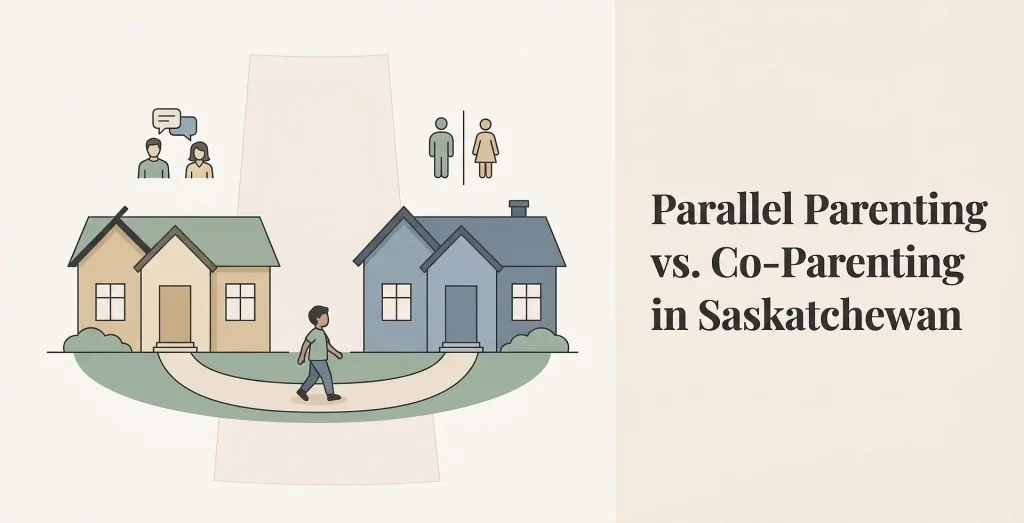
Think of it as two separate but equal lanes running alongside each other. The parents rarely interact.
The child moves between both without being caught in the middle.
How a Parallel Parenting Plan Works in Saskatchewan
A well-drafted parallel parenting order in Saskatchewan leaves nothing open to interpretation. Every potential conflict point gets resolved in writing before it can become one.
Key features typically include:
- Fixed, detailed schedules – Holidays, birthdays, and school breaks mapped out in advance so there is nothing left to negotiate
- Written-only communication – Through apps like TalkingParents or AppClose, which log every message and reduce the chance of verbal confrontations
- Neutral exchange locations – School parking lots or community centres for pickups and drop-offs, keeping direct contact minimal
- Independent day-to-day authority – The parent with the child handles all routine decisions during their parenting time without consulting the other
- Divided major decisions – In some plans, one parent leads on education while the other leads on healthcare
Saskatchewan case law supports this model directly.
In Warcop v. Warcop (2009 SKQB 226), the Court of King’s Bench recognized parallel parenting as an appropriate judicial response where documented conflict makes direct cooperation harmful to children.
When Courts and Lawyers Recommend Parallel Parenting
A high-conflict parenting plan in Saskatchewan becomes necessary in specific circumstances.
Courts and family law professionals typically recommend parallel parenting in specific situations. A documented history of family violence, repeated breaches of prior parenting orders, or false allegations made during custody disputes all point toward this model.
So does communication that consistently breaks down into hostility during or after exchanges.
The research is detailed on one point.
Shielding children from parental conflict matters more than the specific structure of the parenting arrangement. A parallel parenting plan, done properly, achieves exactly that.
=
Legal Requirements Every Saskatchewan Parent Must Know
Saskatchewan law does not let parenting disputes go straight to court anymore. Before anything reaches a judge, both parents must work through a formal resolution process first.
Dispute Resolution Before Court Is Now Mandatory
Before any contested parenting matter reaches the Court of King’s Bench, Saskatchewan extended mandatory early family dispute resolution province-wide on July 1, 2022, requiring all parties to attempt FDR, such as mediation or collaborative law, before contested proceedings may continue in court.
Acceptable FDR processes include mediation, collaborative family law, arbitration, and parenting coordination.
The Saskatchewan Dispute Resolution Office offers subsidized mediation on a sliding scale.
Families earning under $40,000 annually may qualify for free sessions. For families earning between $40,000 and $60,000, the first session costs $200.
That fee scales up to $1,700 per session for households earning over $100,000. Private mediators typically charge $150 to $350 per hour.
Courts can waive the FDR requirement in cases involving serious family violence or child abduction risk, but exemptions are rare.
The High-Conflict Parenting Course That Courts Actually Order
For families in high-conflict situations, standard PAS is not enough.
Courts can order the Parenting After Separation for Families in High Conflict (PASHC) course. This six-section program covers how conflict harms children, emotional management strategies, boundary-setting, and a dedicated section on developing parallel parenting plans.
Failing to complete the required PAS or PASHC course carries real consequences.
A court can strike a party’s pleadings or refuse their submissions entirely. This is not a formality. It is a condition of proceeding.
What the Court of King’s Bench Requires in Practice
The Court of King’s Bench governs all parenting proceedings through Family Practice Directives (FAM-PDs).
FAM-PD 2 makes parenting education mandatory before contested matters proceed. Family Practice Directive 7 governs Judicial Case Conferences, where judges work with parties to resolve disputes before a matter reaches trial.
From January 2, 2026, the Court of King’s Bench Family Focused Protocol made FDR compliance a firm precondition province-wide.
Before any court assistance is granted, all parties must complete the PAS course, attempt alternative dispute resolution, and provide full financial disclosure.
Co-Parenting vs. Parallel Parenting at a Glance
Every family’s situation is different. This table shows where the two models diverge, so you can see clearly which one fits yours.
| Feature | Co-Parenting | Parallel Parenting |
| Communication | Regular, verbal and written | Minimal, written or app-based only |
| Decision-Making | Joint on major issues | Independent per parenting time |
| Schedule Flexibility | Flexible by mutual agreement | Fixed, detailed, pre-set |
| Parent Contact | Collaborative, ongoing | Limited, neutral exchange points |
| Events Attendance | Joint where possible | Separate or alternating |
| Best For | Low-conflict, cooperative exes | High-conflict or abusive dynamics |
| Child Benefit | Consistency, unified parenting | Protection from conflict and stress |
| Legal Framework | Divorce Act s. 16(3) | Warcop framework; PASHC court orders |
How to Move from Conflict to a Working Parallel Parenting Plan
If your current situation is unworkable but you are not sure how to formalize a plan, these are the practical next steps for Saskatchewan families.
- Complete the PASHC course. It is free and available online through a Saskatchewan Account. Courts look for this first in high-conflict files.
- Engage a parenting coordinator. Under the Children’s Law Act, 2020, courts can appoint a coordinator to help implement your parenting order. Costs range from $200 to $400 per hour.
- Draft a detailed parallel parenting plan. Document exchange locations, communication methods, decision-making protocols, and holiday schedules in full.
- Attempt FDR before court. Contact the Dispute Resolution Office at 1-866-257-0927 or hire a private mediator to negotiate plan terms before filing.
- File with the Court of King’s Bench. Contested applications cost $300 to file. Uncontested petitions are $200.
- Apply for a variation if life changes. If circumstances shift materially, you can vary an existing parenting order under Divorce Act Section 17 for a $50 filing fee.
Pro Tip: Some families start with parallel parenting and gradually move toward co-parenting as trust rebuilds over time. That evolution is entirely possible, and worth working toward for your children.
The Right Parenting Model Starts with the Right Legal Advice
There is no universal answer to parallel parenting vs. co-parenting in Saskatchewan.
Co-parenting is the right model when both parents can communicate and cooperate, and the courts will actively push you toward it.
Shared parenting time in Saskatchewan under the 2026 framework reflects just how strongly the system favours meaningful involvement from both parents when the environment is safe.
But when conflict is too high, parallel parenting is not a compromise.
It is the most protective tool available for your children. Both models, executed properly, give your children the stability and security they need from both parents.
If you are working through a parenting dispute in Moose Jaw or anywhere across Saskatchewan, speak with an experienced family lawyer before you file anything.
The right plan protects more than your parenting rights. It protects the people it is all for.
What Saskatchewan Parents Ask About Co-Parenting and Parallel Parenting
What is the difference between parallel parenting and co-parenting in Saskatchewan?
Co-parenting requires joint communication and shared decisions; parallel parenting gives each parent independent authority during their own parenting time.
Does Saskatchewan law require a specific parenting course for high-conflict cases?
Yes, courts can order the PASHC course covering conflict impact, boundary-setting, and how to build a parallel parenting plan.
Can a Saskatchewan judge order parallel parenting instead of co-parenting?
Yes, Saskatchewan courts recognize parallel parenting as a legitimate judicial response where conflict makes direct cooperation harmful to children.
How does communication work in a parallel parenting arrangement?
All communication is written and conducted through logged apps like TalkingParents or AppClose to reduce conflict.
Is parallel parenting better than co-parenting for high-conflict families?
Yes, when conflict consistently exposes children to hostility, parallel parenting is the more protective model for children.
What are the legal requirements for a parenting plan in Saskatchewan?
Both parents must complete the PAS course, attempt family dispute resolution, and provide financial disclosure before court proceedings can advance.
How are major decisions made in a parallel parenting model?
Responsibility is divided by category, with one parent leading on education and the other on healthcare, removing the need for joint agreement.
